
India's top listed companies reported their best-ever quarterly net profit of Rs 2.39 trillion in the September quarter of FY22, up 46.4 per cent year-on-year. The earnings were driven by a big surge in the profitability of banks, non-banking financial companies & insurance (BFSI), oil & gas, and metal & mining firms. The combined net profit of these three cyclical sectors were up 87 per cent YoY to a record high of Rs 1.53 trillion, up from Rs 82,000 crore a year ago and Rs 1.08 trillion in Q1FY22.
.jpg)
The RBI said lead indicators point to continuing sluggishness in domestic economic activity in the first quarter of 2014-15.

'Those who want stability in life have started looking at opportunities outside of the start-up ecosystem.'

Corporate India is more dependent than before on exporters of IT services such as Tata Consultancy Services (TCS), Infosys, and Wipro for earning foreign exchange. Such companies account for nearly 43 per cent of the forex revenues of listed firms, up from 22 per cent a decade ago. The listed IT services companies earned nearly Rs 4.2 trillion through exports in FY22, up 15 per cent from the Rs 3.65 trillion a year earlier. In comparison, the forex revenues or exports of the rest of the BSE500 companies were down 11.9 per cent to Rs 5.6 trillion last financial year.

The early results from corporate India for the first quarter of 2015-16 are in, and these strongly suggest that a cyclical recovery is underway.

One of the reasons is the increasing number of upgrades in analysts' recommendations.

India's industrial production contracted by 3.6 per cent in February, official data showed on Monday. According to the Index of Industrial Production (IIP) data released by the National Statistical Office (NSO), manufacturing sector output declined by 3.7 per cent in February 2021. Retail inflation rose to 5.52 per cent in March, mainly on account of higher food prices, government data showed on Monday. The consumer price index (CPI) based retail inflation stood at 5.03 per cent in February.

'Top lines will grow, volume growth will be there, but margins might also be impacted.'

Indian companies are investing up to $600 million every year and creating jobs and contributing to the British economy.

The Lok Sabha contest in Thiruvananthapuram is shaping up to be a significant battle involving key candidates like Shashi Tharoor, Rajeev Chandrasekhar, and Panniyan Ravindran. This three-cornered fight highlights the political dynamics in Kerala's capital city, with each candidate bringing their own vision and promises for the region's development, notes Rajeev Srinivasan.

The government has only taken a pause and more measures will be announced in the days to come to help sectors hit by the coronavirus outbreak and also to make India 'Atmanirbhar Bharat', Minister of State for Finance Anurag Thakur said. Since the outbreak of the pandemic, the government has taken several steps to mitigate the hardships of the people due to lockdown and support growth, Thakur told PTI in an interview.

In a bid to strengthen their bilateral economic ties, India and Indonesia plan to explore opportunities for co-operation in oil and gas, and railway sectors, among other areas.

Manufacturing sector grows at 3.5%; agriculture sector at 3.8%

Prabhu-led advisory group also suggests JVs with mining and infra firms.

Adani Enterprises, the flagship company of the Adani Group, reported a profit after tax of Rs 557 crore for the first quarter ended June 30, 2014 on the back of a 43 per cent jump in revenue.

The main issues confronting CFOs currently, according to Deloitte, are the current economic slowdown, a depreciating rupee and inflation.

India's economy grew by 1.6 per cent in the fourth quarter of 2020-21, restricting the full-year contraction to 7.3 per cent, official data showed on Monday. The fourth quarter growth was better than the 0.5 per cent expansion in the previous October-December quarter of 2020-21. The gross domestic product (GDP) had expanded by 3 per cent in the corresponding January-March period of 2019-20, according to data released by the National Statistical Office (NSO).

Rajan also said the outlook for agriculture is subdued, in view of both rabi and kharif prospects being hit by monsoon vagaries.

The bad loans of public sector banks were at 4.4 per cent in March 2014 compared with 2.09 per cent in 2008-09, it said, adding, the gross NPA increased by almost four times from March 2010 (Rs 59,972 crore or Rs 599.72 billion) to March 2014 (Rs 2,04,249 crore or Rs 2,042.49 billion).

Index of industrial production data had also shown that the sector grew at 3.1 per cent after contracting in the previous quarters.

Sentiment was largely positive after April IIP grew at 4.9 per cent, spurred by higher growth in manufacturing and mining sectors.

Manufacturing sector production registered a decline of 17.1 per cent, while the output of mining and power fell 19.8 per cent and 10 per cent, respectively.

Out of 30 key export sectors, as many as 22 showed negative growth in September.

The country's gross domestic product (GDP) is likely to grow more than 9.5 per cent in fiscal 2021-22, an SBI research report-Ecowrap said. The economy grew at 8.4 per cent in the second quarter of the current fiscal, according to data released by the National Statistical Office (NSO) on Tuesday. The growth in the April-June quarter of this fiscal stood at 20.1 per cent. In October's monetary policy review, the Reserve Bank of India had retained its projection for real GDP growth at 9.5 per cent in 2021-22, consisting of 7.9 per cent in Q2; 6.8 per cent in Q3; and 6.1 per cent in Q4 of 2021-22.
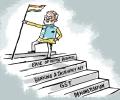
India's GDP expanded 13.5 per cent in the April-June quarter, the quickest pace in a year, to retain the world's fastest growing economy tag but rising interest costs and the looming threat of a recession in major world economies could slow the momentum in the coming quarters.

HSBC on Monday lowered India's GDP forecast for the current financial year to 4 per cent from 5.5 per cent earlier saying economic uncertainty is likely to weigh on the growth forecast in the coming months.

India Inc on Thursday pitched for continuation of reforms while ensuring tax and policy stability in the forthcoming Budget to prop up the economy hit hard by the COVID-19 pandemic. In the virtual pre-Budget consultation held with Finance Minister Nirmala Sitharaman, industry chambers said that government measures will help firmly entrench the nascent signs of recovery being currently seen in private investment. Capital expenditure by the government through enhanced infrastructure spending should in the meantime continue to support growth, CII president TV Narendran said.

Niti Aayog's plan to create a 'New India' in less than four years should invite scepticism, argues T N Ninan.
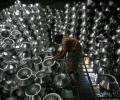
Hindalco's first quarter (Q1FY23) results indicate healthy domestic volumes for aluminium and copper, and lower cost of production. Subsidiary Novelis saw weak volume trends but it managed to push operating profit margins on a better mix and pricing hikes. The weak global outlook on aluminium is a cause for ongoing concern.

In a recent lecture, RBI governor Raghuram Rajan dished out some frank advice -- don't get into 'jugaad', instead try for the long haul. Only that will sustain in the long-run.

The new orders sub-index, which includes domestic demand as well as orders from abroad, rose to 53.2 in May

The country's near-term outlook hinged on a benign inflation trajectory, uptick in industrial activity and falling crude oil prices

10 high dividend paying stocks across sectors that are expected to maintain or even increase their pay-outs in FY23 thanks to faster earnings growth in the last four quarters.
.jpg)
The agency has kept its FY15 growth forecast unchanged at 5.6 per cent.
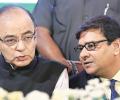
'The one sector where there is still a sense of crisis is banking, but the government has regrettably set its face against privatising any of the government-owned banks,' says T N Ninan.

Investment in infrastructure was necessary for the economy, as power shortages, inadequate transport and poor connectivity affect overall growth performance, as per the Economic Survey 2019-20 tabled in Parliament by Union Finance and Corporate Affairs Minister Nirmala Sitharaman. "To achieve GDP of USD 5 trillion by 2024-25, India needs to spend about USD 1.4 trillion (Rs 100 lakh crore) over these years on infrastructure so that a lack of infrastructure does not become a constraint to growth," it said.

energy is India's binding supply-side constraint for inclusive growth.
Eight infrastructure industries have posted a growth rate of 8 per cent for September on account of good performance by crude oil, steel and electricity sectors.

Richest Indian Gautam Adani's group, which has grown on acquisitions, has fairly solid fundamentals but debt-funded future acquisitions can start putting pressure on ratings, S&P Global Ratings said on Thursday. Starting out as a commodities trader in 1988, the Adani group has diversified from mines, ports and power plants into airports, data centres and defence. It recently forayed into the cement sector with a $10.5 billion acquisition of Holcim's India units and is also looking to set up an aluminium factory. Most of this expansion has been funded by debt.

Acquisition of stressed infrastructure assets has pushed its debt to over Rs 1 lakh crore, highlighting concerns about its growth strategy.
